What happened when I tested voice-based AI as a coaching tool
Most of the conversation around AI in coaching tends to fall into two camps.
Either:
- “This is the future, it will replace everything”
Or:
- “This will never replace real human interaction”
I wasn’t looking to take a position or argue either case.
I just wanted to answer two simple questions:
Can AI hold a conversation that feels real enough for coaching?
And if it can… would anyone actually use it?
The approach
I ran two small experiments using my voice-based AI coaching tools:
- Supercommunication Coach
- Eulogy Workshop Coach
Each had 10 participants.
The key decision was to separate the problem:
1. Does it feel natural?
2. Would people actually use it?
Because those are not the same thing.
Something can feel impressive…
…and still never get used.
Experiment 1: Does it feel natural?
This was about the experience.
Not the content.
Not the advice.
Just the feeling of the interaction.
The result
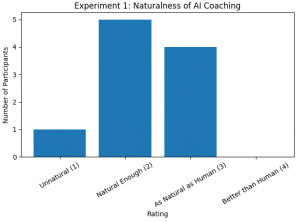
- 90% said it felt natural enough to use or better
- 40% said it felt as natural as talking to a real person
- 1 person said it felt unnatural
That’s a meaningful shift.
What actually happened in the conversation
People didn’t go in thinking, “this is great.”
There was a moment at the start where it felt new… slightly unfamiliar.
Then something changed.
- “Felt surprisingly natural after the first minute”
- “I stopped thinking about the fact it was AI”
- “It felt like a real back-and-forth”
Voice makes a difference.
Typing feels like using a tool.
Talking feels like being in a conversation.
Where it still breaks
It wasn’t perfect.
A few consistent friction points showed up:
- Slight delays or interruptions
- Occasional generic responses
- Moments where it felt just a bit off
Nothing major. But enough to remind people.
Experiment 2: Would people actually use it?
This is where the real question sits.
Even if something feels natural…
Does it earn a place in how people behave?
The result
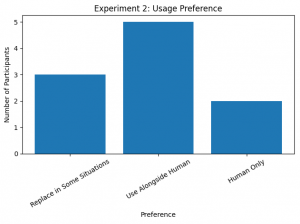
- 80% said they would use it in
- some form
- Of those:
- 30% would use it instead of a human coach in certain situations
- 50% would use it alongside a human coach
- 20% said they wouldn’t use it at all
Where it works
People were quite clear about where it fits.
- Thinking through something before a conversation
- Practising difficult discussions
- Quick reflection
- Working through ideas without involving another person
One comment stuck:
“It’s useful when you don’t want to bring someone else into it yet.”
Where it doesn’t
The boundaries were just as clear:
- Deep emotional topics
- Situations needing real empathy
- Longer-term development
People still want a person there.
The shift I didn’t expect
Going into this, I assumed the main barrier would be resistance.
That people would say:
- “This feels strange”
- “I wouldn’t use this”
That’s not what happened.
What actually showed up was something simpler:
The hesitation disappears quickly once people try it.
The barrier isn’t deep-rooted resistance.
It’s just getting someone to have that first conversation.
After that, the question changes.
Not:
- “Does this work?”
But:
- “Where does this fit?”
Putting it together
The pattern across both experiments is straightforward:
Naturalness → Comfort → Trust → Use
Once the interaction crosses a certain threshold of naturalness:
- People relax
- They engage
- And many start to use it
But they don’t use it everywhere.
They place it carefully.
What this suggests
This isn’t about replacing coaching.
It’s about changing when and how coaching happens.
- More frequent, smaller moments
- Less friction to start thinking things through
- Support in between human conversations
In practice:
AI doesn’t replace the coach
It extends the coaching space
What matters next
This was a small test.
But it’s enough to move past theory.
The question isn’t:
- “Does this work?”
It’s now:
- How do you get people to try it once?
- Where does it genuinely add value?
- What removes the last bits of friction?
Final thought
There’s a simple line running through all of this:
If it feels real enough, people will use it.
We’re not fully there yet.
But we’re close enough that the conversation needs to move on.
From:
- “Will this ever work?”
To:
- “Where does this belong?”