I remember sitting in a large financial services organisation many years ago listening to a senior leader explain the order of organisational responsibility.
First came the shareholder.
Second came the customer.
Third came the employee.
At the time, it surprised me.
Not because financial performance didn’t matter — of course it did — but because the people doing the work felt almost secondary to the system itself.
Over the years, working across large organisations and transformation environments, I kept seeing the same pattern repeated in different forms.
Financial performance wasn’t simply important.
It often became the dominant lens through which almost everything was viewed:
- decision-making
- leadership priorities
- ways of working
- workload
- staffing
- time pressures
- organisational change
And yet, at the same time, many organisations were struggling with the human consequences that emerged underneath those systems:
- disengagement
- low trust
- burnout
- weak collaboration
- short-term thinking
- high turnover
- declining resilience
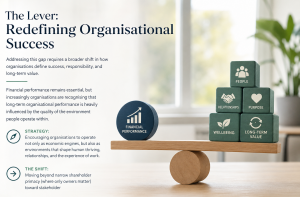
What increasingly became clear is that organisational performance is heavily influenced by the quality of the environment people operate within.
That environment shapes:
- motivation
- relationships
- thinking
- decision-making
- adaptability
- learning
- sustainable performance
This is where a broader shift in organisational thinking is starting to emerge.
Financial performance remains essential. Businesses need to perform commercially. They need to create value, remain competitive, and deliver results.
But a growing number of organisations are beginning to recognise that long-term success cannot be separated from the human experience created inside the organisation itself.
The conversation is gradually expanding beyond narrow shareholder primacy toward a broader stakeholder perspective.
Not because organisations are becoming less commercial.
But because many leaders are starting to realise that thriving people, healthier relationships, stronger cultures, and more sustainable ways of working are not separate from performance.
They are part of it.
This does not mean replacing commercial goals with social goals.
It means recognising that organisations are not only economic engines.
They are also environments that shape how people experience work every day.
And over time, the quality of that experience influences the long-term health, adaptability, and performance of the organisation itself.