Yesterday, I talked about the three building blocks of everyday life: wellness, illness, and hygiene factors (or dissatisfiers). Most people bundle all three together under the vague heading of “wellbeing,” and then wonder why nothing seems to work. We treat damp housing with meditation, quiet desperation with gratitude journalling, and long-term dissatisfaction with a podcast about morning routines. As I said before: you can’t achieve nirvana if the toilet is broken. That framework was about what makes up our inner landscape — the three domains that constantly shape how life feels.
This article looks at the same territory from the other angle — how to work with it. Not the ingredients, but the method. If the first article was the geography, this one is the map-reading skills. And both together give you something that most people never bother to develop: a way to make sense of everyday life, rather than stumbling through it hoping things magically improve.
The problem is simple: most people want better wellbeing, but they don’t know what to do with the issues, challenges, and aspirations that make up normal life. They treat everything the same way. Something feels off? Do more mindfulness. Feeling overwhelmed? Try a productivity hack. Relationship wobble? Buy a new notebook. We apply the wrong tools to the wrong things, and then wonder why life feels heavy.
Here’s the reality: wellbeing is a skill, not a mood. And like any skill, it needs a framework.
The simplest and most practical way to do that is to stop treating everything as “a problem” and instead ask a different question:
What kind of work does this actually need? That’s where a simple sense-making framework helps.
The Four Modes of Everyday Life
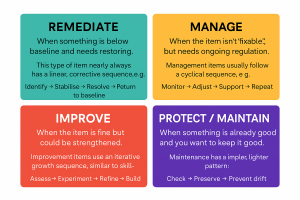
Life throws up different kinds of challenges — some need fixing, some need managing, some need building, and some just need preserving. Once you see life in terms of the four modes — Remediate, Manage, Improve, Protect — everything becomes easier to navigate. Each mode demands a different approach, different energy, and a different mindset. Mix them up, and you’ll spend years frustrated. Match them well, and everyday life becomes far more workable.
1. Remediate
When something is below baseline and needs restoring.
Sequence: Identify → Stabilise → Resolve → Return to baseline
This is for things that genuinely need fixing — the leaking roof, the credit card letter, the argument you’ve been avoiding, the chronic stress that’s tipping into illness.
You can’t “positive mindset” your way out of these.
They need practical action.
Sometimes professional help.
Sometimes a difficult conversation.
Always honesty.
2. Manage
When the item isn’t fixable, but needs ongoing regulation.
Sequence: Monitor → Adjust → Support → Repeat
Some things are lifelong companions — anxiety, a medical condition, financial constraints, a difficult boss, a recurring pattern.
You can’t magic them away, but you can regulate them.
Management is not failure.
It’s skill.
3. Improve
When something is fine, but could be strengthened.
Sequence: Assess → Experiment → Refine → Build
This is the fun bit — the personal-growth side.
Learning, mastery, fitness, social connection, purpose, contribution, creativity, curiosity.
This domain gives you energy, momentum, and life satisfaction.
It’s the part that moves you forward, not just keeps you afloat.
4. Protect / Maintain
When something is already good — and you want to keep it good.
Sequence: Check → Preserve → Prevent Drift
This is the least glamorous and most underrated mode.
Great friendships? Easy to lose.
Good financial habits? Easy to drift.
Stable routines? One busy month and they quietly fall apart.
Protecting the good stuff is part of wellbeing — not an afterthought.
What This Framework Actually Gives You
Once you see life through these four modes, everything gets clearer.
A wellbeing practice isn’t a vague “be happier” project — it becomes a set of decisions:
- Is this something to fix?
- Something to manage?
- Something to improve?
- Something to protect?
Each mode has a different toolkit.
Each mode uses a different type of effort.
And crucially — the wrong approach makes things worse.
You can’t improve your way out of illness.
You can’t manage your way out of a dissatisfier.
You can’t protect something that was never built.
But once you match the right approach to the right situation, life gets dramatically easier to navigate.