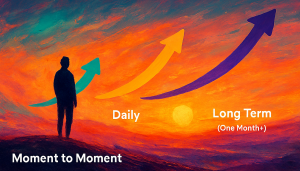
Wellbeing doesn’t operate on one timescale.
Some parts of your life take years to nourish; others take minutes.
Most people lump everything together — and then wonder why nothing changes.
In the first two articles, I laid out the three domains of life (including the Dissatisfiers — those things that collapse your wellbeing faster than a broken boiler) and a framework for choosing what kind of work a situation needs. This article zooms in on Wellness alone and introduces something new: the three time horizons that shape how Wellness actually behaves…
We often think of wellbeing as a single, monolithic goal—something to be achieved and maintained. But what if our mental and emotional health operates across different timescales, each requiring its own kind of attention? A useful model for intentional living breaks our wellbeing into three distinct horizons: the Long-Term, the Daily, and the Immediate. By understanding and engaging with each, we move from reactive survival to proactive thriving.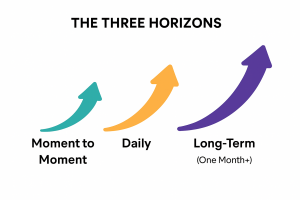
Horizon Three: The Long-Term (Weeks to Years)
This is the horizon of foundation and identity. It encompasses the slow-moving, structural elements of our lives that provide deep-rooted sustenance: our sense of meaning and purpose, overall life satisfaction, the alignment of our career with our values, our spiritual orientation, and the quality of our most enduring relationships.
These are not elements we “fix” on a Tuesday afternoon. They are the bedrock, shaped by significant choices and periodic, profound reflection. Think of this horizon as the architectural blueprint of your wellbeing. You don’t redesign the blueprint daily, but you periodically check if the structure being built still matches the plan. Interventions here are about improvement and course-correction—asking big questions, setting life-direction goals, and investing in relationships and skills that compound over years. It’s the fuel of existential security, reminding us why we do what we do.
Horizon Two: The Daily (Hours to One Day)
If the long-term is the blueprint, the daily horizon is the maintenance schedule. This is the rhythm of lifestyle—the things we must replenish nearly every day to function well. It includes movement, nourishing food, moments of joy or play, daily routines that create stability, and for most, meaningful connection with loved ones. It also houses the ongoing practice of emotional regulation and the accumulation of small, meaningful achievements.
This horizon is about management and maintenance. It’s the daily nourishment that prevents our system from depleting. Neglecting it is like skipping meals or sleep; the deficit quickly manifests as irritability, low energy, or anxiety. The daily horizon transforms the abstract long-term values—like “family” or “health”—into tangible, repeated actions. It’s the crucial layer where intention becomes sustained behaviour, creating the stable platform from which we can engage with both our long-term vision and immediate challenges.
Horizon One: The Immediate (Seconds to Minutes)
This is the horizon of moment-to-moment regulation, and it is the most powerful—and often most elusive—of the three. It exists in the realm of seconds and minutes: a conscious breath taken at a stressful moment, the deliberate pause before a reaction, the noticing of a beautiful sky, the feeling of a micro-achievement after sending a difficult email.
This is nervous system territory. It is where “intentional living” is ultimately won or lost, not in grand declarations but in a thousand tiny moments of choice. It is the domain of remediation and reset. While surprisingly difficult to master, cultivating skill here is the key to resilience. It allows us to navigate daily stresses without derailing our Daily Horizon rhythms and to stay connected to our Long-Term purpose even in turmoil. These high-frequency, short-duration actions are the steering adjustments that keep us on course.
Why the Horizon Model Matters
An item’s time horizon determines everything about how we approach it: how often it needs attention, how quickly we can expect change, and what kind of intervention is right.
For instance, you improve your Life Satisfaction (Long-Term) through annual reflections and bold decisions. You maintain your wellbeing through Daily Movement (Daily). You remediate Acute Stress (Immediate) with a breath technique. Confusing the horizons leads to frustration—you cannot meditate once to solve a lifelong meaning crisis (applying an Immediate tool to a Long-Term issue), nor can you find lasting peace solely through an annual goal-setting session (applying a Long-Term tool to an Immediate need).
The power lies in their synergy. The Long-Term horizon provides the “why,” the direction. The Daily horizon provides the consistent “how,” the healthy rhythm. The Immediate horizon provides the real-time “adjustment,” the in-the-moment agency. Together, they form a complete framework for wellbeing.
Start by reflecting on your blueprint in Horizon Three. Then, audit the daily nourishment of Horizon Two. Finally, and most critically, begin to practice the microscopic awareness of Horizon One. Wellbeing isn’t a distant destination to reach, but a dynamic balance to navigate across these three scales of time, from the years that shape your story down to the very breath that shapes this moment.